
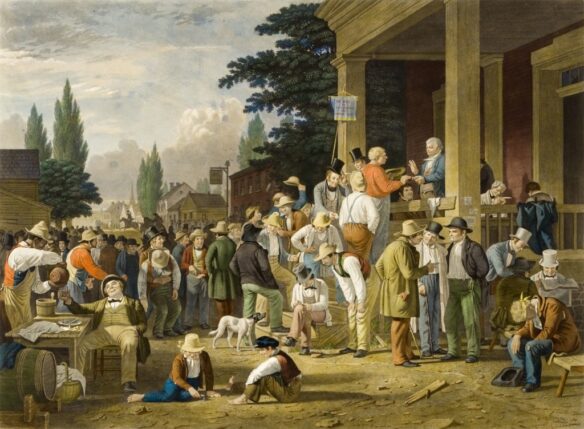
The first tuesday after the first monday in November. After the harvest. Before the snow. Not on market days. And above all: not on the Lord’s Day! The curious history behind America’s Election Day.
This Tuesday, Americans head to the polls for the midterm elections. According to the so-called Presidential Election Day Act of 1845, U.S. presidential elections take place on „the Tuesday next after the first Monday in the month of November.”
The same rule also applies to congressional elections, alongside numerous state and local elections – sometimes even for offices as unexpected as county coroner! But how on earth did they come up with that?
For half a century, the states were able to select their presidential electors on different days, ultimately within a 34-day period leading up to their meeting in December. Long journeys, sluggish procedures, and weeks spent compiling the results. Organizing an election this way – with stagecoaches, messengers, and federal bureaucracy, sometimes even in the depths of winter – was a logistical feat and not without its irregularities.
In elections for the House of Representatives, the timing varied even more widely across the states. Improved transportation routes, railroads, the postal service, and the telegraph would gradually benefit election organization and vote counting.
When technology changed the rules
But modern technology also brought new challenges. Faster communication could compromise free and fair voting in an election lasting several weeks: results from states where voting had already taken place could become known elsewhere even before voters there had cast their ballots.
Added to this was the concern about election fraud, including multiple voting in different states. Electric telegraphy using the Morse code system was still in its infancy at that time. The first connection between Washington and Baltimore had only gone into operation in 1844. But a new speed of information exchange was already becoming apparent.
The shift from several weeks to a single, unified Election Day offered an enormous simplification and was legally regarded as an improvement for getting organizational and informational problems under control. Initially in 1845 for the presidential electors, and then, with a law passed in 1872, also for elections to the House of Representatives.
But even settling on a single day was a challenge in itself. For there were several things to consider when determining an election day for federal elections. For one thing, something as mundane as elections was supposed to take place only after the planting and harvest seasons, so that people would not be disturbed while working in the fields or tending to their livestock.
Lecture in a seminar taught by Marcel Schütz, in German
It was not to be later than early November, since the sometimes harsh continental American winter – with blizzards, deep snow, and freezing cold – made it arduous to travel to distant polling places. One might naively think of the Sunday elections familiar to us in Germany. But for heaven’s sake, voting was not to take place on the Lord’s Day. On Sundays, with prayer and worship, it was God’s turn alone – not the president or Congress.
Finding the right day
Monday was also out of the question, since it often took a full day to reach the widely scattered polling places in county seats, which would have required setting out as early as Sunday. Wednesday was market day in many places, when farmers wanted to sell their goods. The other weekdays, too, had to contend with well-established work and market routines.
That left Tuesday. What was intended as a practical solution in an agrarian society has, in part, backfired in the modern working world. This is another reason why absentee voting and early voting are a relief for many today. Proposals to move the election to the weekend or to make Tuesday a nationwide holiday have so far been unsuccessful.
By the way: Of course, as mentioned, it’s not simply the first Tuesday in November, but – just to be on the safe side – the first (!) Tuesday after (!) the first (!) Monday (!). After all, otherwise the first Tuesday could fall on November 1. And that is All Saints’ Day. The fact that people shouldn’t vote on this Christian holiday is actually cited as one explanation for the rule.
Historically, however, there is better evidence for a completely secular reason: On the first of the month, many merchants settled the accounts for the previous month. In some places, court proceedings were also scheduled. Apparently, people didn’t want to disrupt those either – all in keeping with a rather pious work ethic.
And so, out of 365 days, it became a Tuesday following the first Monday. November 2 at the earliest, November 8 at the latest. Simple as that.
Marcel Schütz is a professor of organizational studies at NBS Northern Business School in Hamburg, Germany. He also teaches at Bielefeld University and the University of Oldenburg. A short portrait of Donald Trump as a political figure was published in German in the Swiss newspaper Neue Zürcher Zeitung (NZZ). An interview with him conducted by his university on the occasion of the 2024 U.S. presidential election is also available to read.
Schreibe einen Kommentar